Learning gaps: why prior knowledge matters, and what to do next
A learning gap is not just about being behind. It is a signal that the foundation for the next stage of learning is missing. Here is how to think about diagnosis, prior knowledge and targeted instruction.
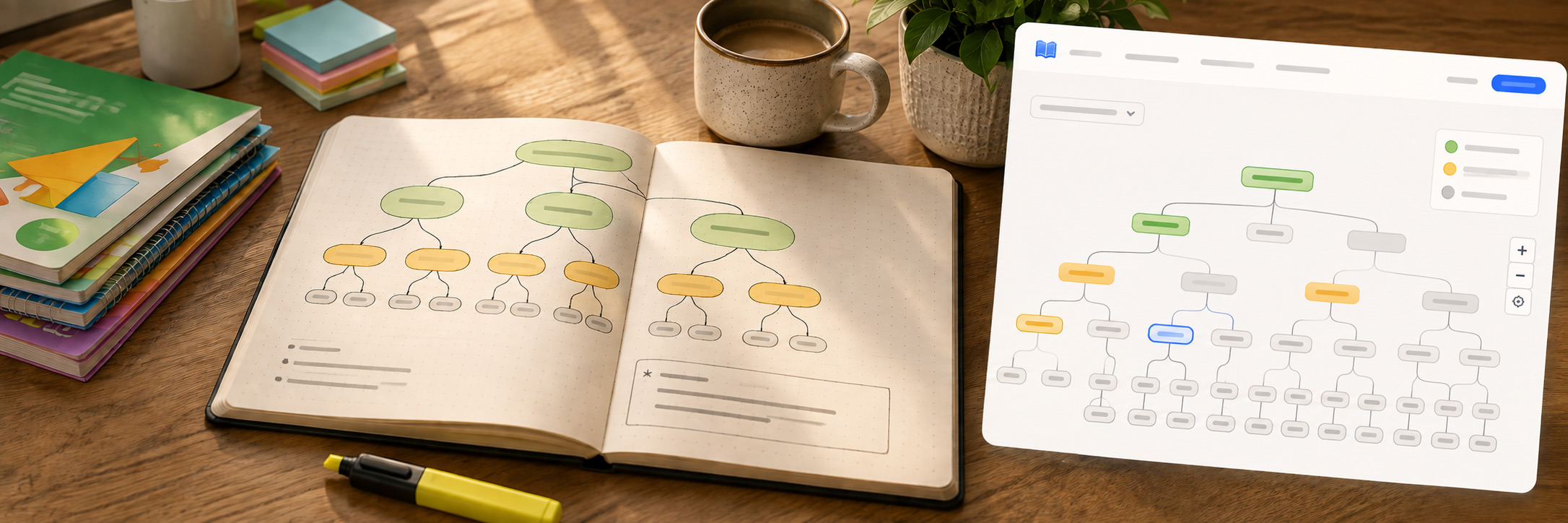
Learning gaps are not simply about students being "behind". From a curriculum perspective, a learning gap occurs when a student lacks the knowledge or skills needed to successfully access the next stage of learning.
This is why prior knowledge matters.
New learning builds on what a student already knows. When prior knowledge is secure, students have a foundation for understanding increasingly complex concepts. When it is incomplete, insecure or based on misconceptions, new learning becomes much harder.
So, when a student struggles, the most useful question is not simply:
"What can't this student do?"
It is:
"What does this student already know, what is missing, and what do they need to know next?"
What is a learning gap?
A learning gap is the difference between what a student is expected to know or be able to do at a particular point in the curriculum, and what they can currently demonstrate independently.
But the point at which the difficulty becomes visible is not necessarily where the gap began.
A student struggling with fractions, for example, may have an underlying gap in number sense, multiplication or equivalence. A student struggling with written analysis may understand the text but lack the vocabulary, sentence structures or knowledge of how evidence supports an argument.
Identifying the visible difficulty is therefore only the first step.
Why is prior knowledge so important?
Prior knowledge provides the foundation for new learning. Students understand new concepts by connecting them to what they already know.
Importantly, prior knowledge includes both how to do something and the content itself.
Consider persuasive writing. A student might be asked to argue for or against banning mobile phones in schools. To write persuasively, the student needs knowledge of how persuasive texts work: sentence structure, paragraph organisation, argument, evidence, audience and rhetorical techniques.
But that is only part of the equation.
The student also needs sufficient knowledge of the topic to develop a meaningful argument. What are the potential effects of mobile phones on learning, concentration and social interaction? How might phones be useful for learning or communication? What are the arguments on both sides?
Without this knowledge, even a student who understands the structure of persuasive writing may struggle to produce a strong response.
This is an important distinction when identifying learning gaps. What appears to be a writing gap may actually be a knowledge gap in writing well about the topic.
Effective curriculum design, therefore, needs to build both disciplinary knowledge (how to write) and content knowledge (what students have to write about).
How can teachers identify learning gaps?
Assessment needs to do more than identify whether an answer is right or wrong.
Diagnostic and formative assessment can help teachers determine what students know, identify misconceptions and locate missing prerequisite knowledge.
Evidence might come from questioning, classroom discussion, retrieval activities, student work, short diagnostic tasks, worked examples and error analysis.
The purpose is to identify where understanding begins to break down.
A test score might tell us that a student is struggling. A good diagnostic assessment helps explain why.
Map the gap through the curriculum
Once a learning gap has been identified, teachers can work backwards through the curriculum progression.
Ask:
What prior and prerequisite knowledge does the student need to successfully access this learning outcome?
Curriculum mapping allows teachers to trace the sequence of learning and identify the point at which knowledge becomes insecure.
Effective intervention can then target the underlying gap rather than repeatedly reteaching the current task.
What should teachers do about learning gaps?
More practice is not always the answer.
If a student understands a concept but lacks fluency, additional practice may be appropriate. But if foundational knowledge is missing, repeating the same type of activity can reinforce confusion rather than resolve it.
A more effective instructional sequence is:
Diagnose → Identify prior knowledge → Address the gap → Explicitly teach → Practise → Reassess → Reconnect
Teachers can use explicit instruction, modelling, worked examples, scaffolding and guided practice to rebuild missing knowledge.
As understanding becomes more secure, support should gradually be reduced, and students should have opportunities to retrieve and apply their learning independently.
Most importantly, the repaired knowledge needs to be reconnected to the current curriculum so students can move forward.
Differentiation should support access, not lower expectations
Addressing learning gaps does not mean automatically giving students easier work.
Effective differentiation maintains an ambitious curriculum destination while adjusting the pathway and support required to reach it.
One student may need vocabulary pre-teaching. Another may need additional modelling. Another may need a visual or concrete representation of a concept. Another may understand the concept but require more retrieval and practice to develop fluency.
The learning goal can remain consistent even when the instructional approach differs.
Can curriculum design prevent learning gaps?
Not every learning gap can be prevented, but strong curriculum design can reduce their likelihood and help teachers identify them earlier.
A coherent curriculum carefully sequences knowledge, connects new learning to prior learning and deliberately revisits important concepts over time.
Through regular retrieval of prior learning, spaced opportunities to revisit key concepts, and assessments that include previously taught content, teachers can identify when knowledge has not been retained or when gaps are emerging.
This creates a curriculum in which learning is cumulative rather than a series of disconnected topics.
The key question
Learning gaps provide valuable information about where curriculum and instruction need to respond.
When a student struggles, we should look beyond the immediate task and examine the learning progression beneath it.
The most useful question becomes:
"What does this student already know, where does their understanding become insecure, and what do they need to learn next?"
When prior knowledge, curriculum sequencing, diagnostic assessment and targeted instruction work together, intervention becomes more precise. And students have a stronger foundation for what comes next.
Studyladder's activities are mapped to specific outcomes across the primary curriculum, so teachers can identify where students are strong, where understanding is insecure, and which prerequisite skills to target next. Start a 30-day free teacher trial.
Keep reading

Numeracy vs mathematical fluency: what the research actually says
These terms are sometimes used interchangeably, but they are not synonyms. A plain-language explainer for parents, teachers and school leaders.

Curriculum-aligned learning: what it actually means for your child
Every online learning tool claims to be "curriculum-aligned". Here is what that phrase really means, and how to check whether a program lives up to it.

Why phonics still matters in Year 3 and beyond
Phonics is often treated as a Foundation-Year 2 topic. Here is why it is still doing quiet work in Year 3, Year 4 and further up the school.